A storefront has two jobs that pull in opposite directions: be open, visible and inviting by day, and be secure after hours. The right security closure depends on how much protection you need, how much you want passers-by to see when you’re closed, and how the opening is used during the day.
Key takeaways
- Rolling security grilles and perforated rolling doors give security with visibility and airflow.
- Solid rolling steel and riot-resistant doors give the most protection.
- Aluminum rolling doors and shutters suit semi-secure locations where appearance matters.
- In NYC, the 70% visibility requirement for storefront grilles was repealed in July 2026. New grilles still need a DOB permit.
What changed in NYC in 2026
For years, NYC’s Local Law 75 of 2009 required sidewalk-facing roll-down grilles on business and mercantile buildings to allow at least 70% visibility, with a compliance deadline of July 1, 2026. In 2026, the City Council passed Intro 910-A to repeal those provisions, and it was enacted as Local Law 123 of 2026 (NYC Council).
According to the NYC Department of Buildings (DOB):
- “The 70% visibility requirement in Local Law 75 of 2009 and the July 1, 2026, deadline no longer apply.” Owners can choose the level of visibility that meets their needs.
- New grilles (where there’s no existing grille) still need a DOB permit and must be shown on plans.
- Replacing an existing grille doesn’t always need a permit, but does when the work affects structural elements or means of egress.
- Motorized grilles also need an electrical permit.
DOB advises speaking with a design professional to find out whether a permit is needed. (Landmarked buildings and buildings in historic districts were exempt from the old visibility rule.) Visibility is now your choice — but many owners still want a see-through closure, for after-hours window displays, light on the street and a storefront that doesn’t look shuttered.
Your options, from most visible to most secure
Rolling security grilles
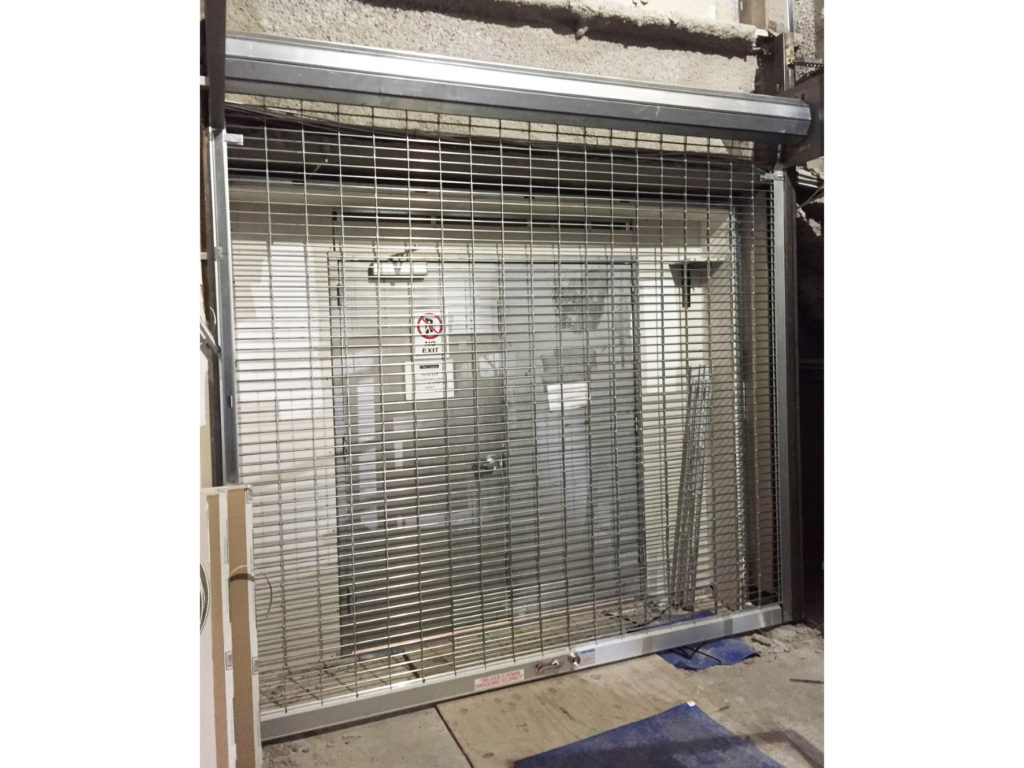
Our rolling security grilles are made of aluminum vertical links, steel horizontal rods and aluminum spacer tubes, for openings up to 20′ high and 42′ wide. They’re built for places where “visibility or ventilation is required,” and come in several patterns — 9″ columns standard, with 6″, 4″, 3″, 2″ and brick patterns available. Operation is by chain hoist or motor, with slide bolts, padlockable chains or cylinder locks, and finishes in clear or bronze anodized, galvanized, stainless steel or powder coat.
Best for: retail shops and offices that want the storefront visible after hours.
Side-folding (accordion) grilles
Sliding/folding security grilles stack to the side instead of coiling overhead. They’re top-hung with no floor track, span up to 30′ without a bi-part (unlimited with bi-parts) and lock with keyed cylinders and drop bolts.
Best for: malls, airports and concourses, or storefronts with no room for a coil above the opening.
Rolling doors with perforated or punched slats
Punched metal slats give a steel rolling door ventilation and visibility “even when it’s closed.” You can perforate the whole curtain or only part of it — for example, a perforated top half over a solid bottom.
Best for: owners who want more protection than a grille with some visibility.
Aluminum rolling doors and shutters
- EntrexGuard rolling aluminum doors — extruded aluminum and clear polycarbonate slats, with optional perforations for ventilation and view, up to 19′ x 25′. They coil into a compact housing above a hung ceiling, and finishes include white, clear anodized, grey and dark bronze. Suited to semi-secure locations where appearance matters.
- DefendaGuard aluminum window shutters — for windows and storefronts, controlled by switch, remote, Wi-Fi or app.
Best for: semi-secure locations — storefronts inside malls, offices and street-front windows where appearance matters.
Solid and riot-resistant rolling steel doors
Our roll-up riot proof door uses 14- to 20-gauge steel curtains with alternating end locks, plus optional windlocks — up to articulating roller windlocks — to help the curtain resist being pulled out of its tracks. Bollards and guard rails can protect the front.
Best for: high-risk locations and businesses that have experienced break-ins.
Scissor gates
A portable folding steel security scissor gate spans up to 12′ (18′ with an add-on), rolls on rubber wheels, locks wall to wall with a padlock and stores out of the way. Single and double fixed scissor gates are also available for permanent installation.
Best for: securing entrances, inner doors and temporary openings.
Restaurants and food service
- Open-air dining: restaurant glass garage doors and full-view aluminum and glass overhead doors open a dining room to the street in good weather, with glazing options from tempered and Low-E glass to polycarbonate.
- Service windows and counters: the Rolling Shutter Model 500 is a counter shutter for “customer service windows, concession stands, and food service windows,” up to 7′ high and 20′ wide, operated by lift-up, crank or motor.
- Fire-rated counters: where your plans or fire inspector call for a fire-rated counter opening, a fire shutter such as the FireStar® 540 is the answer — and it will need annual testing (see our guide to rolling fire door drop testing).
How to choose
| If you want… | Consider |
|---|---|
| Maximum visibility after hours | Rolling security grille |
| No coil above the opening | Side-folding grille |
| More security, some visibility | Rolling door with perforated slats |
| A clean, upscale look | EntrexGuard aluminum rolling door |
| Maximum protection | Riot-resistant rolling steel door |
| A movable barrier | Portable scissor gate |
A few more things to decide:
- Manual or motorized? Motors are easier to use daily and support keypads, card readers and timers. In NYC they also need an electrical permit.
- Finish. Powder coating in approximately 200 RAL colors lets the closure match your storefront — see PowderGuard® powder coating.
- Egress. Any closure on an exit route has to meet egress rules. Motorized grilles can include emergency egress options.
Common questions
Do NYC storefront grilles still have to be 70% see-through?
No. DOB says the 70% visibility requirement and the July 1, 2026 deadline no longer apply. You can choose your level of visibility, but new grilles still need a DOB permit.
Do I need a permit to replace my storefront grille in NYC?
Not always. DOB requires a permit when the work affects structural elements or means of egress, and motorized grilles need an electrical permit. Check with a design professional.
What’s the most secure storefront closure?
Of the options here, a solid or riot-resistant rolling steel door, with a heavier (lower-gauge) steel curtain and optional windlocks to help resist being forced from the guides.
Secure your storefront
We design, install and service storefront grilles, rolling doors, shutters and gates across the five boroughs, Long Island, Westchester and Rockland. Contact us to talk through options for your location.
Sources
- NYC Council, Int. 910-A (Local Law 123 of 2026)
- NYC Department of Buildings, Info for Business Owners
- Product specifications: americandoor.com product pages linked above.