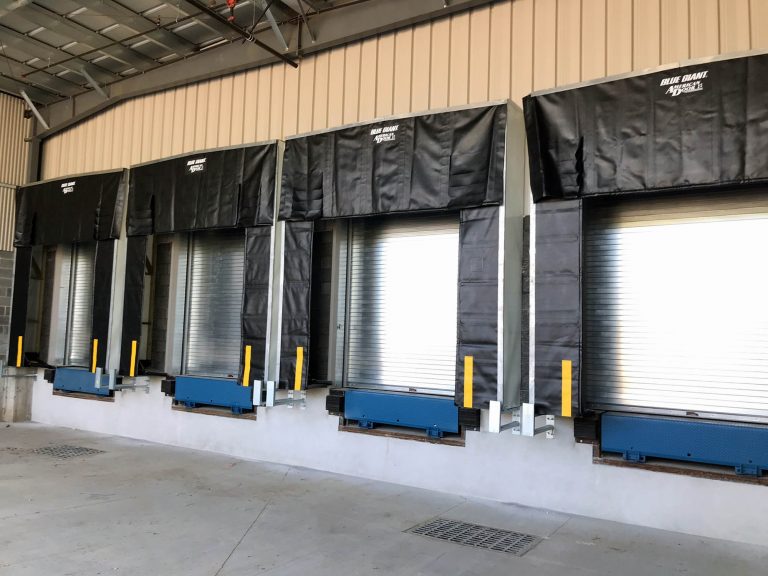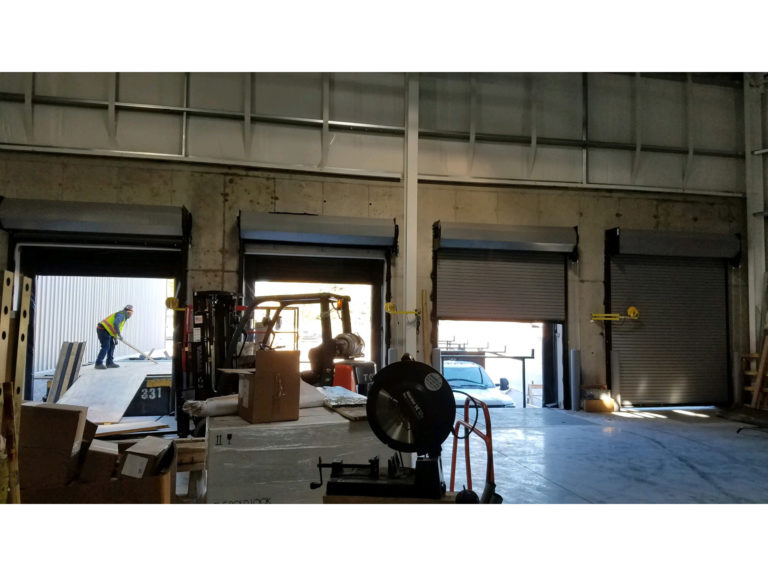
A loading dock is where forklifts, trailers and people meet at a 4-foot drop. A useful way to organize dock safety is around three hazards: the trailer moves, the bridge between dock and trailer gives way, or someone or something goes over the open edge. This checklist covers each one — what OSHA requires and the equipment that helps.
Key takeaways
- OSHA requires truck brakes to be set and wheel chocks placed before a forklift enters a trailer. A vehicle restraint is a widely accepted alternative to chocks.
- Dock plates and levelers must be secured, rated for the load and designed so equipment can’t run off the edge.
- Open dock edges 4 feet or higher need fall protection, with a narrow exception for the working side of the dock.
1. Secure the trailer
What OSHA requires. Under 29 CFR 1910.178(k)(1), “the brakes of highway trucks shall be set and wheel chocks placed under the rear wheels to prevent the trucks from rolling while they are boarded with powered industrial trucks.” Both are required, not one or the other. When a semitrailer isn’t coupled to a tractor, fixed jacks may be needed to keep it from upending.
Why it matters. A trailer that creeps away from the dock as forklifts drive on and off, or a driver who pulls away early, can leave a forklift with nowhere to land.
Your options:
- Wheel chocks. Simple and portable. We recommend two chocks per trailer. Our wheel chocks come in molded, laminated rubber, aluminum and ice models — the ice chock has a sawtooth bottom for icy surfaces and is powder coated safety yellow for visibility.
- Vehicle restraints. A restraint mounted at the dock hooks the trailer’s rear impact guard (ICC bar) and holds it in place. In a 2005 interpretation letter written for postal facilities, OSHA said it would treat missing wheel chocks as a de minimis violation and issue no citation where alternative methods, such as dock locks, prevent truck movement. That covers the chocks only — the brakes still have to be set.
- The StrongArm™ ML10 is fully mechanical — no control panel or wiring — and holds with 30,000 lb of restraining force. Staff engage it with a control rod from the dock, with no bending or lifting, and it can be left locked overnight to discourage trailer theft.
- The StrongArm™ SVR303 is hydraulic, with 35,000 lb of restraining force. Its low 8″ profile catches low ICC bars, and interior and exterior LED lights tell drivers and dock staff when it’s safe. An alarm warns of unsafe conditions, such as a broken or missing ICC bar. It complies with ANSI MH30.3, the standard for vehicle restraint performance and testing.
Checklist
- Brakes set before any forklift enters the trailer
- Wheel chocks placed, or a vehicle restraint engaged
- Two chocks per trailer, kept at every door where they’re used
- Restraint lights working inside and outside; drivers trained to read them
- Uncoupled trailers supported with jacks where needed
2. Bridge the gap safely
What OSHA requires. Dockboards and bridge plates must be “properly secured before they are driven over,” driven over carefully, and never loaded beyond their rated capacity (1910.178(n)(11)). Under 29 CFR 1910.26, dockboards must support the maximum intended load. Dockboards put into service on or after January 17, 2017 must be designed, built and maintained to keep vehicles from running off the edge, unless the employer can show there’s no run-off hazard.
Choose a leveler with the right safety features:
- Mechanical Dock Leveler — a yieldable lip that collapses safely if struck while extended, mechanical fall-safe legs that limit platform free-fall, a hold-down assembly that follows trailer suspension movement, and a maintenance strut for safe inspection.
- U-Series Hydraulic Dock Leveler — push-button operation. If a truck departs early, a velocity fuse limits free-fall of a loaded platform to within 3″. The rear hinge stays flush with the floor to remove pinch points.
- Mechanical Edge-of-Dock Leveler — for docks where a pit isn’t feasible, rated from 20,000 to 30,000 lb.
- Hydraulic Edge-of-Dock Leveler — deploys deck and lip from a remote push-button control station.
For docks without a truck-height match, a dock lift with velocity fuses on each cylinder, toe protection and handrails handles ground-level loading.
Checklist
- Leveler or dock plate rated for your heaviest loaded forklift
- Lip fully on the trailer bed before anyone drives across
- Maintenance strut used whenever anyone works under the deck
- Damaged lips, hinges or hydraulic leaks reported and fixed right away
3. Protect the open edge
What OSHA requires. Walking-working surfaces with an unprotected edge 4 feet or more above a lower level need fall protection (1910.28(b)(1)(i)). There’s an exception for the working side of a loading dock: when the employer can show fall protection isn’t feasible there, work may continue without it — but only while the work is in process, access is limited to authorized employees, and those employees are trained (1910.28(b)(1)(iii)). Talk to your safety professional about how these rules apply to your docks.
Practical ways to protect the edge:
- Dock door barriers. Close or block a dock door whenever no trailer is present. Our Fall Guard door covers the whole dock opening, up to 12′ x 12′, with an 18 oz vinyl or bug-mesh curtain on a 6 or 12 in/sec motor or a manual chain hoist. It’s designed to keep people and rolling objects from going over the edge while the overhead door is open.
- Guard rails on fixed edges and ramps. OSHA guardrail criteria call for a top rail at 42 inches (plus or minus 3 inches) that withstands a force of at least 200 pounds (1910.29). See our guard rails.
Checklist
- Every dock door closed, or blocked with a barrier, when no trailer is present
- Fixed edges, stairs and ramps guarded
- Dock edges marked with high-visibility striping
4. Keep it running: daily habits
- Walk the dock at the start of each shift. Check restraints, lights, leveler lips, seals and doors.
- Check the trailer floor. OSHA requires trailer flooring to be checked for breaks and weakness before it’s driven onto (1910.178(m)(7)).
- Plan for winter. Ice on the approach makes chocks slip; use ice chocks and keep the apron clear.
- Fix damage fast. A bent dock door or broken restraint is a safety issue, not just a repair. Our 24/7 emergency service covers doors and loading dock equipment.
Common questions
Are wheel chocks required if I have a vehicle restraint?
OSHA’s rule calls for wheel chocks, but in a 2005 interpretation OSHA said it would not cite for missing chocks where an alternative such as a dock lock prevents truck movement. Many facilities use both.
What’s the difference between the StrongArm™ ML10 and SVR303?
The ML10 is mechanical, with 30,000 lb of restraining force and no wiring. The SVR303 is hydraulic, with 35,000 lb of restraining force, a lower 8″ profile for low ICC bars, and lights and alarms that communicate with drivers and dock staff.
Does my dock need fall protection when the door is open?
OSHA requires fall protection on edges 4 feet or more above a lower level. The exception for the working side of a loading dock is narrow: the employer must show fall protection isn’t feasible, and it applies only while the work is in process, with access limited to trained, authorized employees. Check with your safety professional how it applies to your docks.
Get your dock assessed
We install and service vehicle restraints, levelers, lifts, dock seals and shelters, fall protection doors and guard rails across the five boroughs, Long Island, Westchester and Rockland. Contact us to have your docks checked.
Sources
- 29 CFR 1910.178, Powered industrial trucks (eCFR)
- 29 CFR 1910.26, Dockboards (OSHA)
- 29 CFR 1910.28 and 1910.29, Fall protection and criteria (eCFR)
- OSHA interpretation letter, September 14, 2005
- Product specifications: americandoor.com product pages linked above.