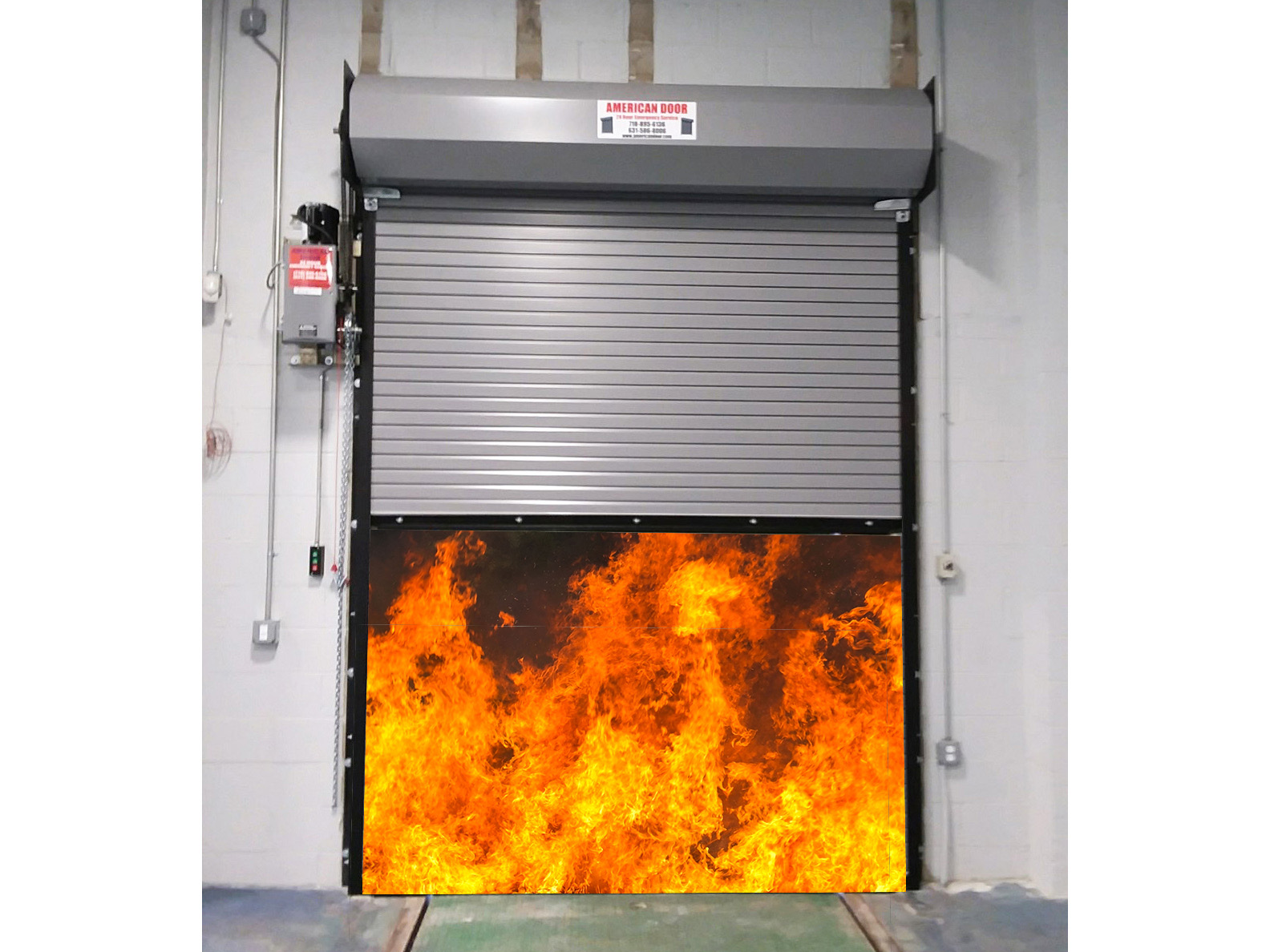
A rolling fire door spends almost its whole life open and out of sight, coiled above an opening. Its one job is to close by itself when there’s a fire, and keep fire and smoke from spreading. The only way to know it will is to test it, which is why rolling fire doors and fire shutters need a drop test at least once a year.
Key takeaways
- A drop test releases the door the way a fire would, and checks that it closes fully on its own at a controlled speed.
- Rolling fire doors must be inspected and drop-tested at least annually — under NFPA 80 (as summarized by the door industry association, DASMA) and the NYC Fire Code — even if they’re rarely used.
- The test should be done by a trained technician and documented. Keep the reports for your fire inspector.
- Test again after installation and after any repair.
What is a drop test?
Rolling fire doors and shutters are held open in normal use. In a fire, a release device — commonly a fusible link that melts at a set temperature, or a signal from the fire alarm or a smoke detector — lets the door close automatically.
A drop test simulates that release. The technician triggers the automatic closing mechanism and watches the door come down. According to the door industry’s technical guidance, the door must close completely and rest on the sill, and its average closing speed must be at least 6 inches per second and no more than 24 inches per second (DASMA TDS #271).
How often is it required?
Annually. DASMA’s technical data sheet on rolling fire doors states that the door “shall be inspected and drop-tested not less than annually by a Trained Rolling Steel Fire Door Systems Technician” (DASMA TDS #271). The same sheet points out that the requirement “applies to all fire doors – even those that are not used and remain in the closed position.”
In New York City, the Fire Code says “horizontal and vertical sliding and rolling fire doors shall be inspected and tested annually” (NYC Fire Code, Chapter 7, FC 703.4, 2014 edition), and that fire doors must be maintained in good working order in accordance with NFPA 80. Check the current FDNY Fire Code and your local fire marshal for the edition that applies to your building.
DASMA’s guidance also calls for a drop test when the door is first installed and after mechanical repairs (DASMA TDS #271; DASMA Ask Joe). If a forklift or truck hits a fire door, have it inspected — and retested after any repair.
What happens during the test
Based on DASMA’s procedure, a typical annual test runs in this order:
- Visual inspection. Mounting, guides, hood, bottom bar, fusible links and operating mechanism are checked for damage, missing parts and obstructions.
- Operational test. The door is opened and closed normally to confirm it moves freely.
- Drop test. The automatic closing device is released. The door must close fully and rest on the sill, within the required speed range.
- Reset and second drop. The door is reset according to the manufacturer’s instructions and dropped again. The second test confirms the closing device was reset correctly.
- Documentation. Results are recorded on a drop test form — location, opening size, manufacturer, pass/fail for each step and the signatures of the tester and a witness.
Who can perform it?
NFPA 80 (2025 edition, as amended by Tentative Interim Amendment 25-1) defines a trained rolling steel fire door systems technician — someone with documented training who is qualified through experience to inspect, test and maintain these doors. Its annex notes that “special training for acceptance testing and periodic inspection and testing is necessary” and that the technician should be able to produce evidence of that training (NFPA TIA 25-1 to NFPA 80, 2025 edition).
Some fire doors and shutters make it easy for your own staff to check them between professional tests. Our Fire-Rated Roll Up Door has an easy field testing mechanism that “allows for maintenance tests between certified professional tests.” The FireStar® 540 fire shutter can be tested with no tools and reset back into operation with no special skills. These in-house checks are useful, but they don’t replace the annual test by a trained technician.
What to keep on file
- The signed drop test report for each door, every year.
- The door’s label information — the fire rating and listing on the door or frame.
- Records of repairs and parts replaced, and the retest that followed.
NFPA 80 annex guidance says periodic inspection and testing “should be documented on a form that complies with industry standards” and that the door should carry an inspection mark (NFPA TIA 25-1). How long to keep records depends on the code edition your jurisdiction has adopted. Industry sources commonly cite at least three years for periodic test records and the life of the door for acceptance-test records — confirm the requirement with your fire inspector, and when in doubt, keep them.
Between tests: what building owners can do
- Keep the opening clear. The NYC Fire Code states that fire doors “shall not be blocked or obstructed or otherwise made inoperable.” Stock, pallets or carts under a rolling fire door will stop it from closing.
- Don’t modify the door. The NYC Fire Code states that “fire door assemblies shall not be modified.” Have any change or repair done by a qualified fire door technician.
- Report damage right away. Dents in the curtain or bent guides can stop the door from closing.
- Schedule the next test before the last one expires. An annual service agreement is the simplest way to stay current.
Fire-rated doors and shutters we install and test
- Fire-Rated Roll Up Door — up to a 4-hour Class A UL rating depending on size and configuration, up to 24′ x 24′.
- Fire-Rated Insulated Roll Up Door — up to 4-hour Class A UL, with mineral-wool insulation and a fusible link that closes the door automatically.
- FireStar® 540 Fire Shutter — a counter fire shutter for hospitals, schools and concessions, with a planetary gear release that disconnects from the operator and drops the shutter in a fire.
- Fire Resistant Rolling Shutter Model 570 — a fully welded counter shutter with a UL 1-1/2 hour Class B label and a fusible link.
Annual drop testing from American Door
We provide annual rolling fire door drop testing across Nassau and Suffolk counties and all five NYC boroughs. Each test comes with a written report on file, and we keep the parts needed to stay compliant on hand, with emergency service if a door fails. Call (888) 226-3667 or contact us to schedule.
Common questions
How often do rolling fire doors need to be drop tested?
At least once a year, under NFPA 80 as summarized by DASMA and under the NYC Fire Code. Also test after installation and after any repair.
What if the door fails the drop test?
It needs to be repaired and retested — until then, the opening isn’t protected. The technician’s report should note what failed, such as a door that stopped short of the sill, closed too fast or too slowly, or a release device that didn’t trip, so the repair can target the cause.
Do fire shutters need testing too?
Yes. Rolling fire shutters are fire-rated assemblies that must also comply with NFPA 80, and our annual drop testing covers both rolling fire doors and fire shutters. Ask your fire inspector about the schedule for your specific shutters.